
Key Highlights:
- Marketing measurements are possibly more important than ever in 2026.
- Out of the many metrics you have at your fingertips, only a few of them actually drive growth. What are they?
- Privacy, AI, and increased competition will change the way you measure your marketing in 2026.
- What should you track at every stage of the funnel?
You already know that tracking marketing metrics is essential, but tracking everything is not. As your business evolves, so should your metrics. The numbers that mattered last year may no longer reflect growth in 2026. This guide helps you identify the few marketing metrics to track that make the biggest difference to your bottom line, so you can stop measuring noise and start measuring results.
What is a Marketing Metric?
A marketing metric is a measurable value used by businesses to assess the effectiveness of their marketing efforts. These metrics help businesses track and analyze the performance of their marketing strategies, campaigns, and activities. By evaluating these metrics, companies can understand how well they are reaching their goals, optimize future marketing efforts, and make data-driven decisions.
Why Measurement Still Matters in 2026
We probably don’t need to tell you that business looks quite different as 2026 approaches than it did a couple of years ago. Competition for customer attention is increasing, privacy regulations are stricter, and customers are using multiple channels before making purchasing decisions. As a business leader, you need data that shows which marketing dollars deliver the most revenue. You need metrics that demonstrate performance to leadership and clients while also helping your team to optimize their tactics in real time.
The right measurement strategy helps you make confident decisions, justify spending, and fine-tune campaigns that actually work.
The Problem with Vanity Metrics
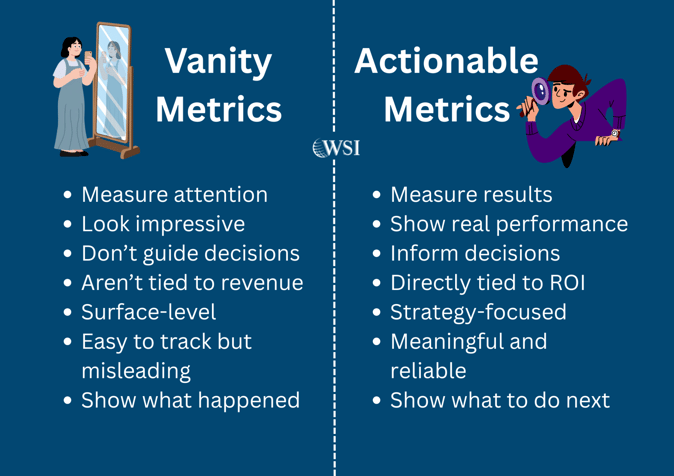
Many metrics seem important but don’t serve your business goals. Likes, impressions, page views—they look impressive, and it’s gratifying when you see them increase, but they rarely connect to leads, conversions, or revenue. If you focus on these vanity metrics, they may give you a false sense of progress while masking the issues you should be dealing with, such as lead quality, conversions, and customer retention.
Vanity metrics don’t provide any actionable insights, and they can mislead you into the mistake of prioritizing quantity over quality.
Other examples of vanity metrics include:
- Website traffic
- Page views
- Downloads and registrations
- Newsletter subscribers
While it is good news when you see these numbers rise, they don’t necessarily translate to sales and conversions. To grow in 2026, focus on metrics that show cause and effect — not just activity.
|
Focus On What Matters |
What’s Changed: Privacy, AI, and Attribution Challenges
Changes in privacy regulations, the rise of AI, and several new attribution challenges have all contributed to current shifts in marketing metrics.
Cookie deprecation and privacy-first tracking reduce cross-site tracking, making it harder to measure user journeys, attribute conversions, and count returning visitors. Since zero-party and first-party data collection is voluntary, it is bound to be less complete. While you could previously track every visitor, now you can only track those who allow you to. Naturally, this will affect the accuracy and completeness of your data.
AI-powered attribution and predictive analytics change how marketers measure engagement and ROI. These tools provide accurate, data-driven insights and enable real-time budget and strategy optimization, facilitating personalized marketing. These tools can potentially offset the limitations imposed by the new data regulations by providing predictive insights, personalization at scale, automation, and efficiency.
Traditional marketing and metrics relied on last-click or single-channel attribution. Previously, conversion credit was assigned to the final customer touchpoint before the conversion occurred. However, the customer journey has changed. It is now multi-touch, multi-channel, and sometimes non-linear, making it very difficult to attribute conversions correctly. It is seldom true that only the last touchpoint led your customer to convert. What about all the preceding steps? They must have had a role to play. With this in mind, it is now essential to understand the entire customer path, from first click to last click.
For business leaders, this means you’ll see smaller but more accurate datasets. Quality data now matters more than volume. This is where AI-driven attribution tools help fill the gaps, offering predictive insights and automated recommendations.
Core Metrics That Drive Real Growth
Now that you’ve filtered out the vanity metrics, focus on the numbers that link directly to ROI and sustainable growth.
Lead Quality Over Quantity: How to Measure the Right Leads
It seems counterintuitive, but you need to stop counting your leads. Instead, focus on gathering the right leads. Rather than simply looking at the total number of leads you have generated, start scoring each lead. This should be done in line with your target market and customer personas. Assess criteria like demographic fit, engagement levels, and conversion likelihood.
High-quality leads translate to more efficient, more productive sales cycles and higher ROI. There’s no point in boasting about an increase in leads when none of them are actually going to convert. HubSpot and similar tools all offer features that let you measure each lead against your buyer personas and sales goals.
This ensures your sales team focuses only on high-value prospects and helps show that your marketing spend attracts the right audience, not just any audience.
Customer Acquisition Cost (CAC) and Lifetime Value (LTV)
Of course, you have cause to celebrate when you bring in a new customer. However, do you know how much it costs to acquire that customer and therefore what your ROI would be?
Get a full understanding of your customer acquisition cost and measure it against the revenue your customers generate so you can ensure your marketing spend is reasonable and going to the right places. You should also measure your lifetime value (LTV—the total amount of money you expect to earn from a single customer over the course of your relationship). Maintain profitable, sustainable marketing investments by tracking the Customer Lifetime Value (LTV) to Customer Acquisition Cost (CAC) ratio.
Return on Ad Spend (ROAS)
ROAS is a key metric that measures the revenue generated for every dollar spent on advertising. It helps businesses determine the effectiveness of their ad campaigns by comparing the return to the ad spend. A higher ROAS indicates a more successful campaign, while a lower ROAS suggests the need for optimization. By tracking ROAS, marketers can allocate budgets more effectively and focus on high-performing ad strategies that maximize profitability.
Cost per Lead (CPL)
Cost per Lead (CPL) measures how much it costs a business to generate a single lead through marketing efforts. It is a valuable metric for assessing the efficiency of lead generation campaigns, as it helps marketers understand how well their budget is being spent to attract potential customers. Lowering CPL while maintaining lead quality is crucial for improving marketing ROI and ensuring that marketing spend is cost-effective.
Average Order Value (AOV)
Average Order Value (AOV) represents the average revenue generated per order and helps businesses understand how much customers spend each time they make a purchase. By increasing AOV, companies can boost revenue without needing to acquire more customers. Strategies to increase AOV include upselling, cross-selling, and offering product bundles. Monitoring AOV helps businesses improve sales performance and pricing strategies to optimize profitability.
Net Promoter Score (NPS)
Net Promoter Score (NPS) measures customer loyalty by asking how likely customers are to recommend a product or service to others. It is calculated by subtracting the percentage of detractors (customers who wouldn't recommend) from the percentage of promoters (customers who would). NPS provides valuable insight into customer satisfaction and brand sentiment, with a higher score indicating a more loyal and satisfied customer base that is likely to drive organic growth through word-of-mouth.
Email Open & Click-Through Rates (CTR)
Email open rate measures the percentage of recipients who open an email, while click-through rate (CTR) tracks the percentage of recipients who click on a link within that email. Both are essential for understanding how well email campaigns are engaging subscribers. A high open rate indicates strong subject lines and interest, while a high CTR shows that the content within the email is compelling and drives action. Monitoring these metrics allows marketers to refine email strategies and improve engagement.
Conversion Rates (And Why They Don’t Tell the Whole Story)
Conversions are important, but context matters. We mentioned before that not all leads are the same. By the same token, a high conversion rate on low-value leads isn’t going to help you. Segment your conversion measurements by channel, campaign, and lead type to get the full picture. Leading analytics platforms, such as Google Analytics and Adobe Analytics, offer features that help you measure conversion rates while accounting for these nuances.
|
Lead Quality Over Quantity |
Metrics by Funnel Stage: What to Track (And Where)
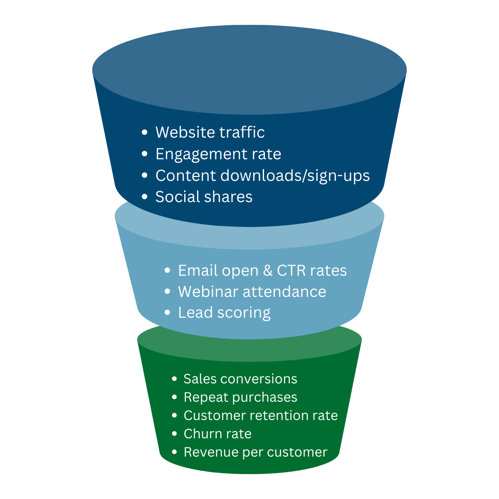
Not all metrics are created equal — each stage of the customer journey tells a different story. Align your tracking with where prospects are in the funnel.
Top-of-Funnel: Awareness and Engagement Signals That Matter
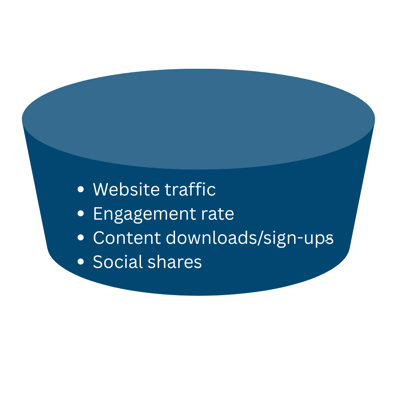
At the top of the funnel, you want to know who you are reaching and how well they are engaging with you. Remember to focus on quality, not quantity. At this stage, keep an eye on metrics like the following:
- Website traffic from targeted sources
- Engagement rate
- Content downloads or sign-ups
- Social shares from relevant audiences
Mid-Funnel: Nurture Metrics That Predict Conversions
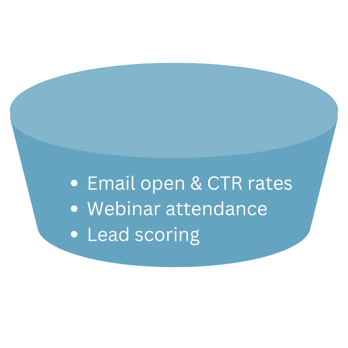
Once you have your customers’ attention and they move down the funnel, the aim is to build trust and give prospects more reasons to commit to your brand and products. Focus on metrics such as the following:
- Email open and click-through rates
- Webinar attendance and participation
- Lead scoring progression
These numbers will tell you whether prospects are moving closer to purchasing.
Bottom-of-Funnel: ROI, Retention, and Revenue
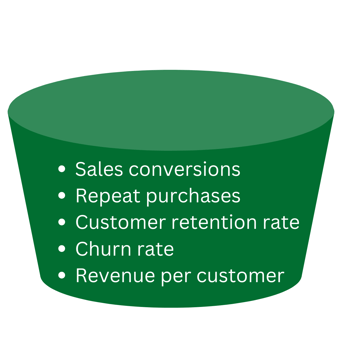
At the point where leads should be converting to sales, look for:
- Sales conversions
- Repeat purchases
- Customer retention rate
- Churn rate
- Revenue per customer
What You Can (Probably) Stop Tracking
On the other hand, there are several metrics you can probably let go of. Check them from time to time, but keep in mind they don’t give you a full, accurate picture of your marketing progress.
Social Media Likes ≠ Business Growth
Likes, followers, and subscribers are nice, and it’s great if your social media platforms are engaging more people, but these figures don’t correlate to revenue. Focus on tracking engagement that leads to action.
Bounce Rate’s Unreliable Cousins
Don’t get too caught up with bounce rates, exit rates, and page views. They can be misleading. When you do glance at them, think about the context: if someone made a quick visit to a page that features your price list, that could mean more than someone spending several minutes reading your latest blog post. Which one of these is more likely to precede a purchase?
Time-on-Site and Other Misleading KPIs
Spending a long time on a page is not a guarantee of interest. It doesn’t matter if someone took the time to peruse your about page. The question is, what did they do next? You want buyers, not readers.
Key Marketing Metrics for Business Leaders
When it comes to performance marketing metrics, you want quick, accessible, meaningful numbers, not dozens of data points that don’t connect to growth. Cut out the noise by focusing on the following metrics. Think of this as your marketing health dashboard — simple, relevant, and actionable.
Five Numbers That Actually Reflect Marketing ROI
- Lead quality score
- LTV-CAC ratio
- Conversion rates by campaign
- Revenue growth per channel
- Customer retention rate
What to Ask Your Marketing Team or Agency
To get down to the relevant facts, ask your marketing team these questions:
- Which campaigns drive the highest-quality leads? This will tell you where to focus your spending and which tactics and campaigns you should rather let go of.
- How are you measuring ROI across channels? This question will help you get an idea of all that important context we’ve been talking about. What is your team measuring, why, and what do these measurements really mean?
- Where should we reallocate our budget for better returns? This one helps to clarify the points revealed in the first question. What part of your marketing spend is working, and what needs to be reconsidered and reallocated?
Reporting for Stakeholders vs. Optimization
The data you gather for stakeholders is not the same as the information you collect and report back to your team. Stakeholders want high-level results; your team needs data they can act on. Use dashboards and summaries to keep the stakeholders informed, and reserve the detailed analytics for your marketing professionals.
Tools to Track Smarter (and Automate Reporting)
Your most valuable tools for campaign success in 2026 will combine CRM, automation, and AI-driven analytics. Platforms like Scratchpad, Zoho, and HubSpot now integrate predictive insights, saving time while improving accuracy.
Common Metric Challenges
Tracking and analyzing marketing metrics can be complex and challenging for businesses. Here are some of the common performance marketing measurements faced when working with marketing metrics:
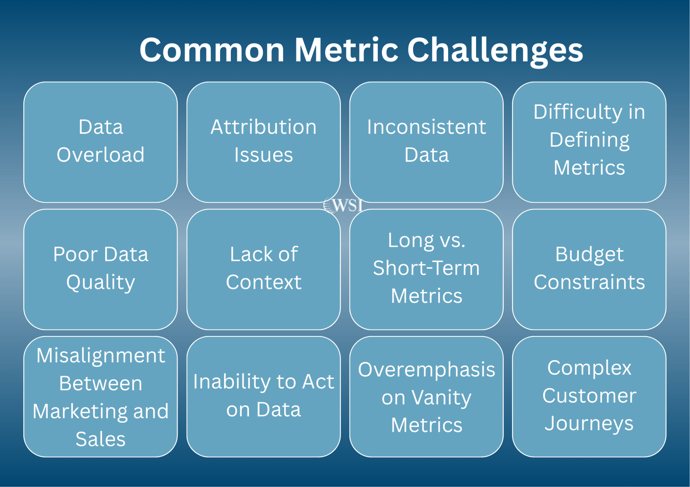
1. Data Overload
- Challenge: With so many marketing channels (social media, email, paid ads, etc.) and various metrics to track (CTR, ROI, CLTV, etc.), it's easy to get overwhelmed by the sheer amount of data available.
- Solution: Prioritize key performance indicators (KPIs) that align with your goals, and focus on the most impactful metrics for your business.
2. Attribution Issues
- Challenge: Determining which marketing efforts are responsible for conversions or sales can be difficult. Customers interact with multiple touchpoints before making a decision, and traditional models like last-click attribution don't always capture the full journey.
- Solution: Use multi-touch attribution models or advanced analytics tools that provide a more comprehensive view of how different marketing channels contribute to conversions.
3. Inconsistent Data
- Challenge: Data from various marketing platforms (Google Analytics, social media, email, CRM systems, etc.) may be inconsistent, making it hard to get a unified picture of performance.
- Solution: Implement a centralized marketing dashboard or use data integration tools to bring all data into one place, ensuring consistency and accuracy.
4. Difficulty in Defining Metrics
- Challenge: Sometimes, it can be unclear which metrics to track or how to define them properly. For example, what exactly counts as a "conversion" or "engagement" can vary depending on the campaign goals.
- Solution: Clearly define and standardize your metrics across the organization before launching campaigns. Ensure everyone has a consistent understanding of what each metric represents.
5. Poor Data Quality
- Challenge: Low-quality data—such as inaccurate tracking, incomplete information, or duplicate records—can skew results and lead to poor decision-making.
- Solution: Regularly clean and validate your data, ensuring accuracy. Invest in tools or services that help maintain high-quality data.
6. Lack of Context
- Challenge: Metrics like "traffic" or "leads" may look good on paper, but don't provide enough context to understand their true value. For example, a high number of leads may not be valuable if they don't convert into sales.
- Solution: Pair metrics with context, such as revenue impact, customer feedback, or sales pipeline data, to provide a deeper understanding of their significance.
7. Tracking Long-Term vs. Short-Term Metrics
- Challenge: Marketers often focus on short-term metrics (like click-through rates or website traffic), while overlooking long-term metrics (like customer lifetime value or brand awareness) that are just as important.
- Solution: Balance short-term and long-term metrics in your marketing strategy. For example, consider both conversion rates and customer retention in your overall assessment of success.
8. Budget Constraints
- Challenge: Limited marketing budgets can make it hard to experiment with new tactics, test campaigns, or access advanced analytics tools to track metrics properly.
- Solution: Focus on high-impact, cost-effective metrics that provide actionable insights. Use free or affordable tools to track basic performance, and scale up as your budget allows.
9. Misalignment Between Marketing and Sales
- Challenge: Marketing teams and sales teams may define success differently, leading to misalignment in tracking and interpreting metrics. For instance, marketing might focus on generating leads, while sales focuses on closing deals.
- Solution: Foster collaboration between marketing and sales teams to ensure they agree on common goals and how to measure success. Aligning on shared metrics, such as qualified leads or sales conversions, can help bridge the gap.
10. Inability to Act on Data
- Challenge: Even with access to detailed metrics, marketers sometimes struggle to act on the data due to a lack of insights, resources, or time to make changes.
- Solution: Develop a system for turning data into actionable insights, such as setting up automated alerts, regular reporting, or conducting data-driven meetings that lead to concrete decisions.
11. Overemphasis on Vanity Metrics
- Challenge: Vanity metrics (such as total website visitors, likes, or impressions) may look impressive but don't necessarily reflect meaningful business outcomes, like sales or customer retention.
- Solution: Focus on metrics that directly tie to business goals and customer behavior, such as conversion rates, customer acquisition cost (CAC), and return on investment (ROI).
12. Complex Customer Journeys
- Challenge: Today's customers interact with brands across multiple touchpoints and devices, making it difficult to track a seamless journey from awareness to purchase.
- Solution: Use tools like customer journey mapping, marketing automation platforms, or advanced tracking technologies (like UTM parameters or cross-device tracking) to understand the full customer journey.
Addressing these challenges involves a combination of selecting the right tools, aligning teams, maintaining data integrity, and using a more holistic approach to measuring and acting on marketing performance. By overcoming these common hurdles, businesses can achieve more accurate and actionable insights.
| Beware of data overload and attribution issues! Make sure to focus on KPIs that align with your business goals, and don’t let irrelevant metrics cloud your decision-making process. |
Closing the Loop: How to Turn Insights Into Action
Data is only valuable if it leads to action. Use your metrics to guide decisions, refine campaigns, and reallocate resources where they’ll have the most impact.
Metrics have little meaning if you don’t have goals to measure them against. Every metric should relate to a specific business outcome, whether it’s lead quality, revenue, or customer retention.
Based on your metrics, you can make an informed decision as to whether your current tactics are worth pursuing or abandoning. Analyze the numbers, note the trends, and decide whether to optimize, scale up or down, or discontinue campaigns. Metrics are not just there for reporting. They should guide, inspire, and inform your actions.
| Metrics are only valuable when they drive decisions. Use your data to refine strategies, reallocate budgets, and boost performance. Optimize based on the numbers that connect to real business outcomes. |
Ready to Track What Matters?
As 2026 unfolds, success depends on clarity — knowing which numbers to trust and which to ignore. The right metrics help you strengthen performance, prove ROI, and stay agile in a shifting market.
At WSI, we help business leaders and marketing teams turn complex data into clear strategies that drive measurable growth. Whether you’re looking to simplify your reporting, improve lead quality, or connect marketing results directly to revenue, our experts can help you track what truly matters.
WSI helps businesses simplify marketing measurement with AI-powered dashboards and clear, actionable insights. Connect with a WSI expert to build your 2026 marketing measurement strategy — and start tracking what truly drives revenue.